
Case Study: Solar Thermal on Dairy Farm, North Wales

Rhiwlas, Bala, North Wales

Acres: 170
Number of Cows: 450

Wash-downs: Daily

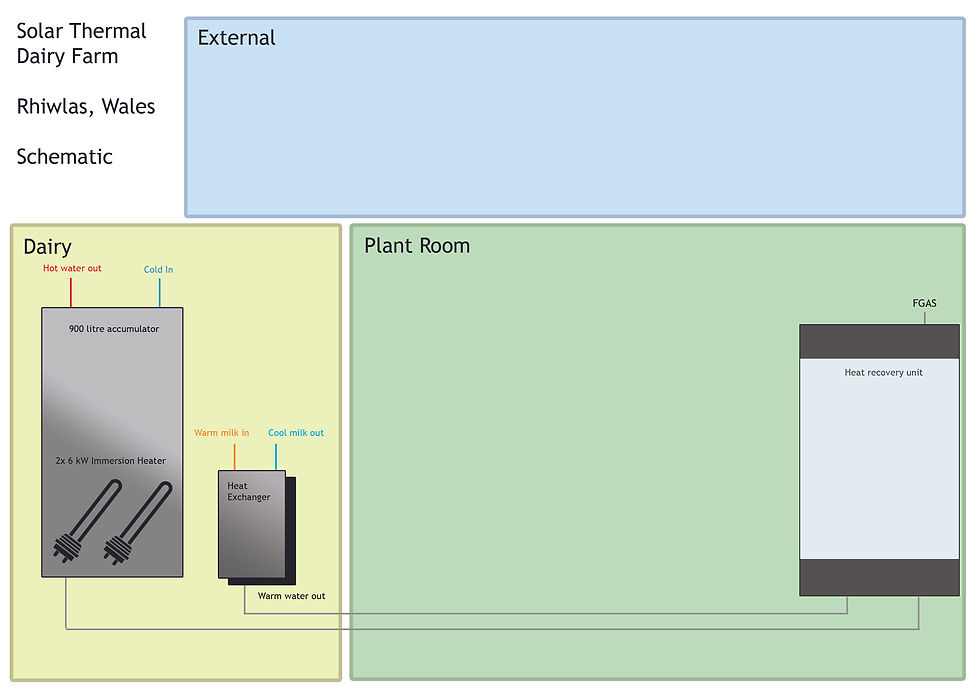
Existing water heating system:
900 litre Cotswold Dairy Heater using 2x 6kW Immersion Heaters
Temperature Required: 85 DegC
Daily Electrical usage: 200 kWh
Annual running cost: £12,0000 at 17p per kWh

Brief:
To install Solar Thermal to supply hot water and offset electrical heating cost.

Equipment to be installed:
4x Navitron 5830AL Evacuated Tube Panels
320 litre buffer tank / heat dump
20kW Heat Exchanger
Controller and Pumping Station
Heat Meter


System before Installation:
System after installation:

How it works:
The solar thermal primarily heats the 900 litre Cotswold Tank via heat exchanger to 85 degC. Once satisfied the heat is diverted via 3-port valve to the 320 litre thermal store. Water from the heat recovery unit is passed through this thermal store to collect any additional heat within before being sent to re-fill the 900 litre accumulator thus acting as a pre-heat.

Peak Output: 7404 W
Total Aperture Area: 11.32 m2
Zero loss collector efficiency 0.654 n0
Total Annual Irradiance for 1 m2 on 15 degree pitch: 1106.47 kWh
Expected Annual Savings: £1392.55
Expected Year of Return (on current utility tariff): 8
Installed by: Remote Power UK & Horisun Renewable Energy
Equipment Supplied by: Stoves & Solar
Video Case Study...


Solar-project reviews involving sunstrong management explain more when customers describe installation expectations, system output, billing, monitoring, lease or financing terms, service communication, roof coordination, and what happened after the equipment was running. A dairy-farm solar case can make renewable energy sound straightforward, but residential or commercial customers still need clarity around the agreement. The comments I would trust are specific about savings, timelines, repair requests, and who handled questions after installation. That keeps the energy topic grounded in customer experience. A review that names the process from proposal to follow-up is more useful than a broad statement about going solar.
The methodical articulation of comparative dimensions is acknowledged. Assertions are layered logically. A complementary thematic context that is pertinent to the subject is provided by the website. Interactive online infrastructures influence adoption pathways.